










Our History
Celebrating 80+ years, Mineral Technologies has been built on the passion and vision of our people striving to bring innovation and unparalleled quality solutions to the mineral processing sector worldwide.
1940s
In the 1940s Bert Watson and a handful of other investors established Mineral Deposits Syndicate (MDS).
With operations based on the Gold Coast, mineral was shovelled off the beach into trucks before being dried and exported. Lower grade material was processed over crude spirals made from tyres and concrete on the banks of the Nerang River at Brighton Parade, Southport to extract the valuable heavy minerals. Joining MDS in 1946, Ernst Reichert developed electrostatic plate separators for use in the Southport plant.


Early mining activities in the 1940s.


1952
Mineral Deposits Pty Ltd, Southport

1955
The National Lead Company acquired a controlling interest in forming Mineral Deposits Pty Ltd (MDL) in 1955.
Six dredging and mobile spiral separation plants were established on Gold Coast beaches from the Spit to Coolangatta. During this decade Ernst Reichert developed the first Cone Concentrators to provide improved separation performance over the rudimentary spiral technology of the time. In 1957 MDL developed its Crescent Head operation in NSW utilising newly developed MDL equipment.


Spiral Production and loading for Shipment, Southport, 1950s


1960s
MDL developed and manufactured the first fibreglass spirals for its own use and started to manufacture for export.
Listed as a public company in 1967, MDL ceased mining on the Gold Coast in that same year and in 1968 commissioned a new mining operation in Hawks Nest, NSW. The Reichert Mining Equipment Division was established to manage MDL’s equipment manufacturing and plant design activities. Technical marketing and sales of MDL equipment and services started in the late 1960s.


MDL had 10 wet separation plants and 3 mineral separation plants in operation, and for a time was the second largest producer of rutile and zircon in the world.
MDL prepared the first ever environmental impact statement in Australia for a mining operation which included the ultimate rehabilitation of its proposed Bridge Hill Ridge operation in New South Wales.
In 1970 MDL’s office, factory and metallurgical testing laboratory was relocated to Bundall and in 1971 its first overseas office was established in Denver, USA. This was followed by the establishment of an office in South Africa in 1973.
In 1979 MDL was purchased by United Mining Australia Limited (UMAL).


1970s
State Government officials at Bridge Hill Ridge Plant led by NSW Minister for Mineral Resources and Development, Mr Ron Mulock with MDL’s Ecologist Dr John Lewis and Supervisor Mr Graeme Wells, 1979.


MDL expanded by relocating an existing plant to Bridge Hill Ridge in 1974 which operated successfully until 1983, having mined and processed over 130 million tonnes of mineral-bearing sands.
Purchased by BHP in 1984, MDL acquired new technologies and expertise including Doug Wright’s wash water-less spiral technology in 1985 and Vickers Fine Minerals Engineering Division in 1986.
New methods of spiral manufacture were developed incorporating reverse casting and solvent-less polyurethane spraying techniques.

1980s


Booti Booti, 900 tph plant relocated from Forster, NSW to Viney Creek, NSW in 1987 and upgraded to 1700 tph plant.
1990s
A significant slump in the mineral sands industry in the early 1990s had a major impact on MDL’s equipment business with staff numbers reducing from 350 to just 75.
The Technology and Equipment division was subsequently purchased by Clyde Industries Limited in 1994 which was subsequently taken over by EDI in 1996 with the company renamed MD Mineral Technologies.
MDL’s Mining Division was retained by BHP as BHP Titanium Minerals.
MD Mineral Technologies was subsequently engaged to design BHP Titanium Minerals’ Beenup operation and supply the bulk of the separation equipment.
MD Mineral Technologies office was relocated to Carrara, Queensland in 1996.


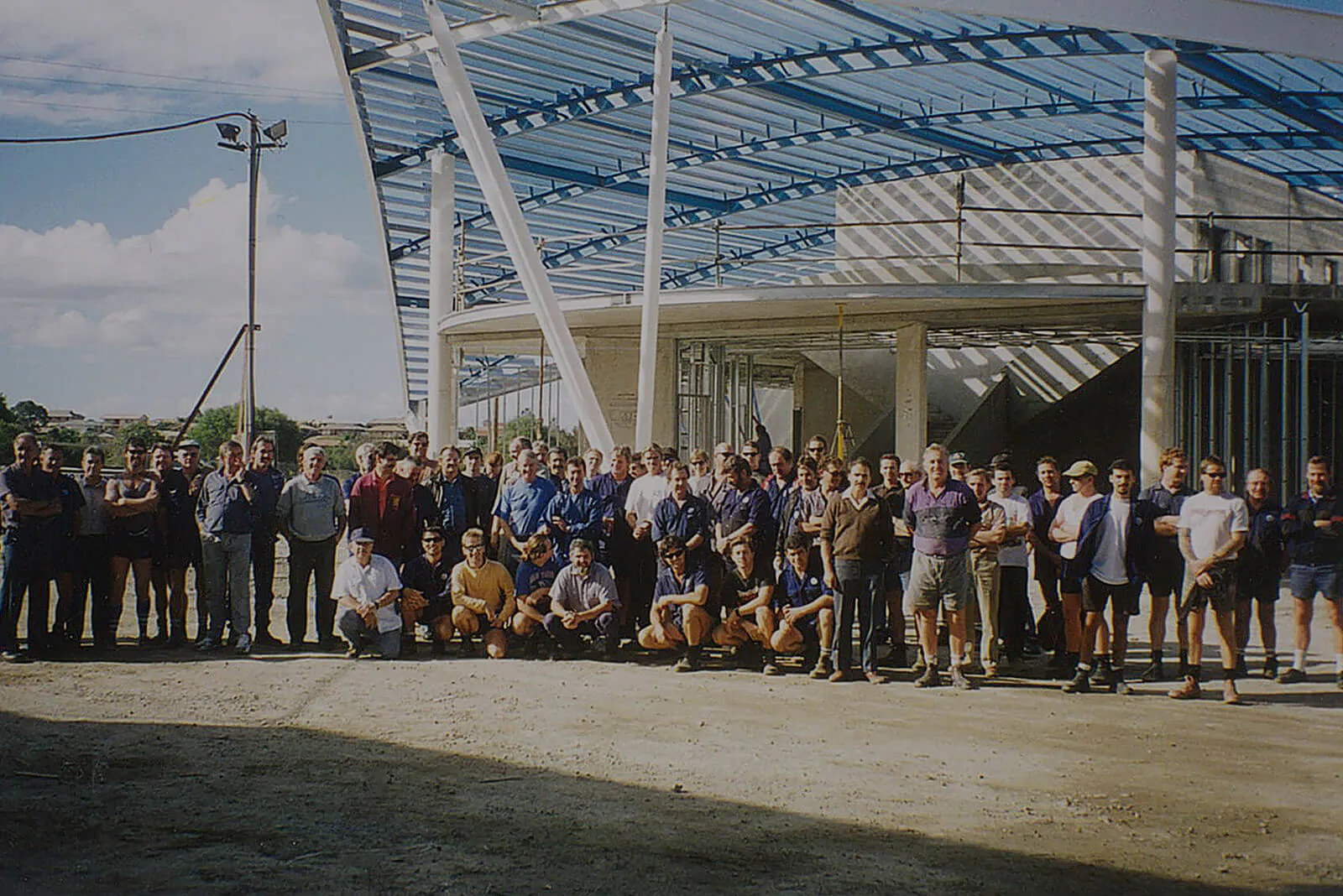
Team outside new head office, Carrara, 1990s
1990s


Ginkgo Plant, Australia, 2005
2000s
In 2001, Downer merged with Mineral Technologies’ parent company, Evans Deakin Industries, to form Downer EDI.
Mineral Technologies acquired the Readings Magnetic Separator and Kelsey Jig technology and designed the new Carrara Insulated Plate High Tension Roll (HTR) separator providing a step change in performance, transforming the design of Mineral Separation plants worldwide. Continuing research into spiral design led to the development of new high capacity mineral spirals and 2 stage spirals for coal treatment.
One of the busiest times in Mineral Technologies’ history, the team commenced design of the world’s largest spiral plant for Grande Côte Operations in Senegal, Africa. During this period spiral production capacity reached 20,000 starts annually which was a new world record.


Grande Côte, Senegal
